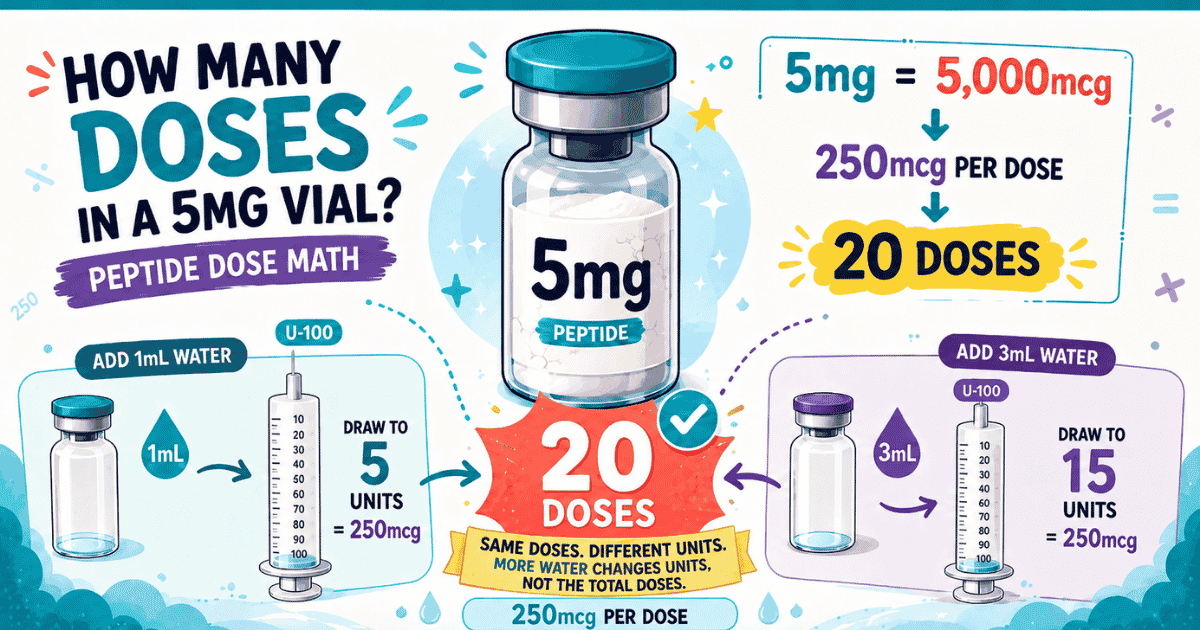
A 5mg vial at a 250mcg dose gives you 20 doses. The formula is doses = (vial mg × 1,000) ÷ dose in mcg, and the amount of bacteriostatic water you add doesn't change the answer.
That last part trips people up constantly, so let's walk through it.
The dose count formula
Doses per vial = (vial mg × 1,000) ÷ dose in mcg
A 5mg vial holds 5,000mcg of compound. Divide by your dose:
- 250mcg dose: 20 doses
- 500mcg dose: 10 doses
- 100mcg dose: 50 doses
Water appears nowhere in that math. Adding water changes the concentration, not the amount of compound in the vial. Whether you add 1mL or 3mL, you still have 5,000mcg to work with. What water changes is how many units you draw per dose. Different question, different formula.
How many units per dose
Concentration first:
Concentration (mg/mL) = vial mg ÷ water mL
Then convert the dose to syringe units:
Units on a U-100 syringe = (dose mcg ÷ (vial mg × 1,000)) × water mL × 100
Worked through with real numbers. A 5mg vial, 2mL of bac water, 250mcg target:
- Concentration: 5 ÷ 2 = 2.5 mg/mL
- Units: (250 ÷ 5,000) × 2 × 100 = 10 units
- Doses: 5,000 ÷ 250 = 20
Each dose is a clean 10 units on a U-100, and the vial lasts 20 doses. If you want to run your own numbers, the reconstitution calculator does all three at once, and the full reconstitution math walkthrough covers every step in detail.
Why your dose reads differently on another syringe
U-100 means 100 units per mL. A U-50 syringe marks 50 units in that same mL, a U-40 marks 40. The identical volume of liquid reads as a different number depending on the scale printed on the barrel.
Insulin users know this well. Switch syringe types and the numbers shift while the liquid stays the same. The liquid didn't change. The ruler did. Misreading the scale is the classic reconstitution dosing error, so check the barrel before you check your math.
Picking water for a clean number
Worth knowing: you can choose your water volume so the dose lands on an easy mark. With a 5mg vial, 2mL gives 10 units per 250mcg dose. Easy to read, easy to repeat. 1.7mL would give 8.5 units, which is a number you don't want to be eyeballing at 7am.
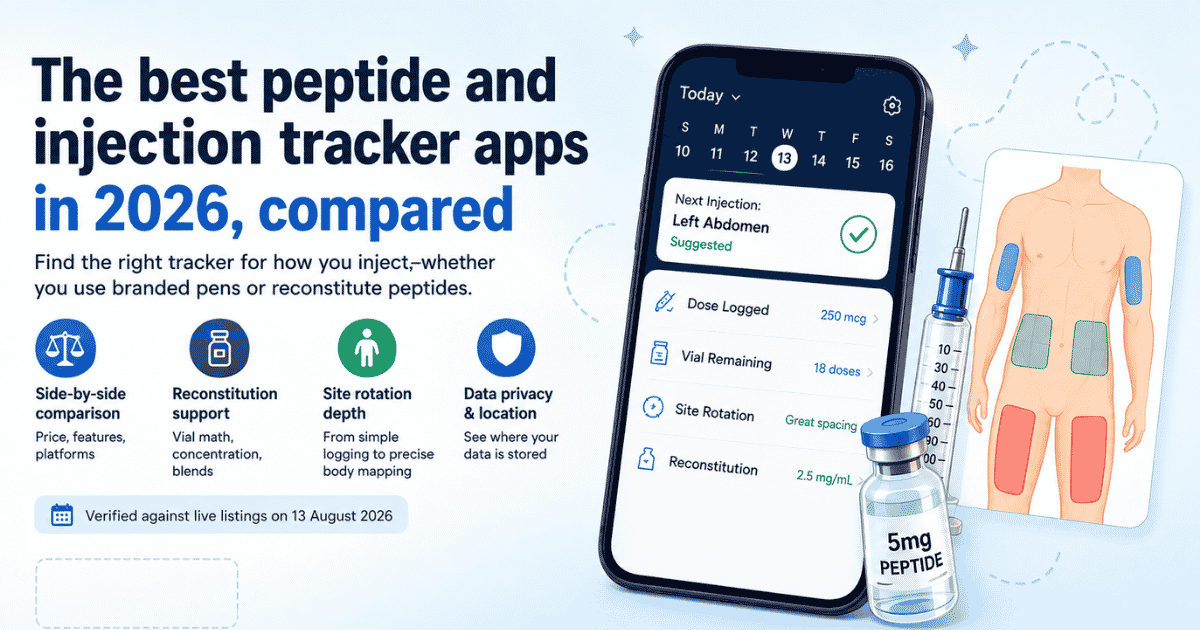
Working backward from the units you want to the water you should add is what a reverse calculator does. PinTrax, an injection manager built around reconstitution math, has a reverse mode for exactly this, and it tracks vial remaining as you log so "how many doses left" stops being mental math.
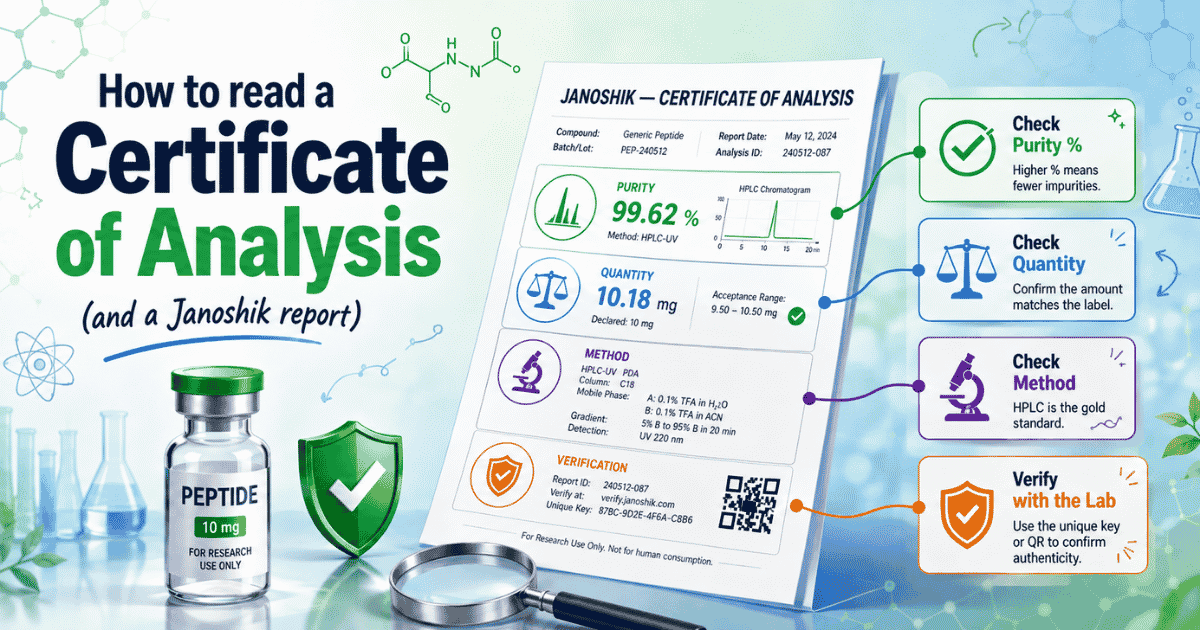
One more wrinkle: the count above assumes the vial contains what the label says. A vial with a stated purity below 100% delivers slightly less per draw, which is what a Certificate of Analysis tells you.
FAQ
How many doses are in a 10mg vial?
Same formula, double the compound. At 250mcg per dose, a 10mg vial gives 40 doses. At 500mcg, 20. Water volume doesn't affect the count.
How many units is 250 mcg?
Depends entirely on concentration. At 2.5 mg/mL (a 5mg vial with 2mL water), 250mcg is 10 units on a U-100 syringe. Different water volume, different answer.
What happens if I add more water?
Your dose count stays the same. More water means lower concentration, so you draw more units per dose, but the vial holds the same total compound either way.
Why does my dose look different on a different syringe?
U-100, U-50, and U-40 syringes print different unit scales over the same volume. 10 units on a U-100 is the same liquid as 5 units on a U-50. Know which scale you're holding.