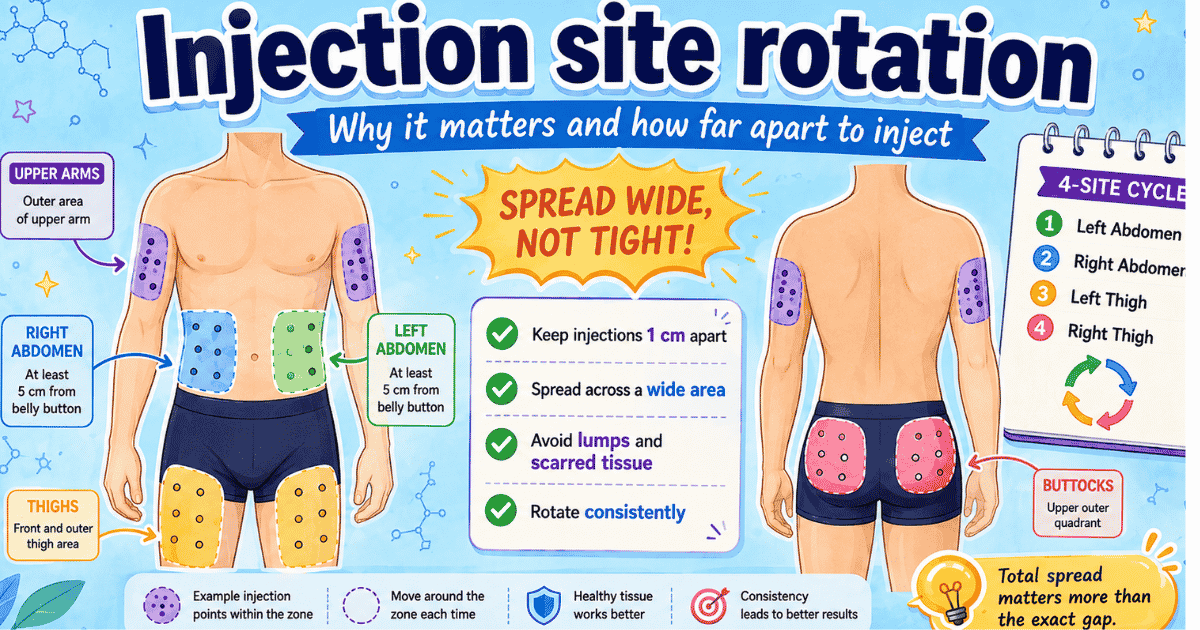
Injection site rotation means moving each shot to fresh tissue so no single patch gets injected over and over. Keep consecutive injections at least 1 cm apart, and spread them across a wide area rather than clustering in one small zone, because total spread matters more than the gap between any two shots.
That second point is the one most rotation advice gets backwards.
What lipohypertrophy is and why it happens
Lipohypertrophy is a lump of thickened, rubbery fat that builds up where injections land in the same place too often. You can usually feel it before you see it: a firm, slightly raised area that's less sensitive than the skin around it. Repeated needle trauma and the local action of what's injected drive the tissue to overgrow.
It matters beyond looks. Injecting into a lump changes absorption, often making it slower and less predictable, so the same dose can behave differently day to day. Insulin users have known this for decades. It applies to anyone injecting subcutaneously on a schedule, GLP-1 and peptide users included.
How far apart should injections be
Keep each injection at least 1 cm from the last, about the width of an adult finger. That is the spacing in a 2019 review of injection technique in Clinical Diabetes, and the Forum for Injection Technique India recommendations (2015) use the same 1 cm within a site. The 2.5 cm figure you may have seen belongs to insulin pump infusion sets, not injections: those same Indian recommendations space infusion sites 2.5 cm apart. The exact figure matters less than the habit of not stacking two shots on the same spot.
Correction, 30 September 2026: an earlier version of this section attributed a 1 to 2 cm range to the FITTER working group and a 2.5 cm rule to nursing material. Neither could be confirmed against an open source, so the section now cites two that could be.
Where it gets interesting is what actually predicts damage.
Spreading wide beats measuring gaps
A 2018 cross-sectional study in Frontiers in Endocrinology examined 372 people with type 1 diabetes using insulin (mean age 17) and found that injecting within a small total area was the strongest predictor of lipohypertrophy. Confining injections to a zone of 8.5 by 5.5 cm or smaller carried an odds ratio of 23.2. Failure to rotate at all came in at 6.3. Both raise risk, but the small-area effect was nearly four times stronger.
Read that again, because it reframes the whole problem. You can rotate diligently inside a palm-sized patch and still be at high risk. The protective move is using the whole available region, both sides of the abdomen, both thighs, upper arms, spread over weeks, not shuffling shots around one corner of your stomach.
A rotation habit that works for insulin and peptides alike
For a daily insulin user, that means working systematically across a large region before returning near a previous spot, keeping each shot a finger's width from the last. For a once-weekly GLP-1 or peptide injection, a simple four-site cycle covers it: left abdomen, right abdomen, left thigh, right thigh, then shift each point a couple of centimeters on the next pass. Stay about 5 cm (two inches) out from the navel; the Indian recommendations place abdominal injection sites 5 cm either side of it. If you feel a lump, skip that area entirely until it recovers.
The hard part isn't the rule. It's remembering, weeks later, exactly where you've been.
Where a body map earns its place
This is the one job an app does better than memory. A coordinate-level body map records the precise spot of every injection rather than a vague "left thigh." A proximity warning flags when your next tap falls within about 1.4 cm (on a 175 cm body) of any injection from the last 14 days, a radius wider than the 1 cm minimum above. A rest-ranked suggestion points you to the tissue that has recovered longest, which is exactly the "spread wide" behavior the research rewards. PinTrax builds all three around a 26-zone map, and the comparison of injection trackers shows how that depth stacks up against a pick-from-a-list rotation feature. The dosing side of the same log ties back to the reconstitution math.
FAQ
How far apart should injections be?
At least 1 cm between consecutive injections, about the width of an adult finger. Spreading injections across a wide region matters even more than the exact gap.
What does lipohypertrophy look like?
A firm, slightly raised, rubbery area at a frequently used injection site, often paler or less sensitive than surrounding skin. You can usually feel it before it's visible. Injecting into it can slow and scatter absorption.
How do I rotate injection sites properly?
Use the full available area rather than one small patch, keep each shot a finger's width from the last, and cycle through regions on a schedule you can track. Avoid any spot that feels lumpy until it heals.
Can I inject in the same spot twice in a row?
Better not to. Repeated same-spot injection is what drives lipohypertrophy, and the research shows confining shots to a small area is the strongest risk factor. Move at least 1 cm each time and rotate widely.
Which sites absorb fastest?
The Forum for Injection Technique India recommendations give the order as abdomen fastest, then upper arm, then thigh, then buttock. Absorption also slows in tissue that has developed lipohypertrophy, which is another reason to keep sites fresh.