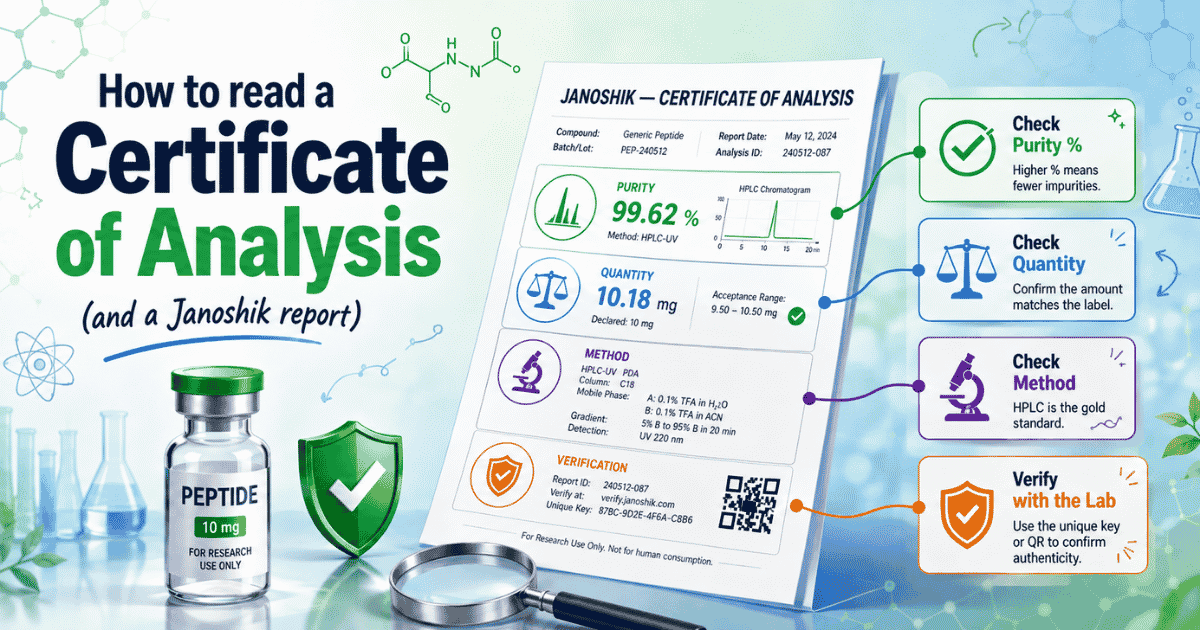
A Certificate of Analysis, or CoA, is a lab document reporting what a specific batch contains: its identity, its purity percentage, and its measured quantity. Learning how to read a CoA means checking four things, the purity figure, the measured mass against the label, the test method, and whether the report traces back to a named lab you can verify.
Everything past that is detail, and the detail is where forged and stale reports fall apart.
What a CoA is and who issues one
A CoA is a batch test report. An independent analytical lab receives a sample, runs it, and documents the result. The value is in the word independent. A document a seller writes about its own product is a self-report, which is worth roughly what a student's self-graded exam is worth.
In the peptide community, the reference lab is Janoshik Analytical, based in Prague. It became the default because it's independent, its reports follow a consistent format, and every genuine report carries a code you can check against the lab's own records. Naming a real lab is itself a signal; a certificate from a lab with no web presence is a red flag on its own.
The fields that matter
Purity percentage. The share of the detected material that is the target molecule, measured by HPLC (high-performance liquid chromatography). A 99% purity result means 1% of what was measured is something else, related impurities, fragments, residue.
Quantity or mass. How much compound the sample actually contained, checked against the label claim. A "10mg" vial rarely tests at exactly 10.00mg, and small variance within a stated range is normal manufacturing reality, not evidence of a problem.
Method and identity. HPLC establishes purity; mass spectrometry (MS) confirms identity, that the molecule is what the label says. A strong report shows both, plus the chromatogram itself, the actual graph. A typed percentage with no chromatogram is a report missing its evidence.
Batch or lot number and verification key. The batch code ties the report to a specific production run, and it must match the code on the vial. The verification key, an alphanumeric string usually near the batch ID, is what lets you authenticate the document.
How to verify a Janoshik report is genuine
Enter the report's unique key at Janoshik's verification page. If the code resolves on the lab's own site, the report is real. If it doesn't resolve, treat the document as fabricated no matter how polished it looks. While you're there, confirm the batch number matches your vial and that the report is recent, within about twelve months, since an old certificate says little about a run produced later.
What a CoA does not tell you
Purity is not identity. A sample can be 99% pure and still be the wrong molecule, which is why the MS identity line matters as much as the HPLC number. Quantity variance within a range is expected, not alarming. And a CoA describes the batch that was tested, not the individual vial in your hand; sellers reorder constantly, and each new run is a separate, untested batch until it's tested. A certificate is evidence about composition. It is not a safety clearance, and it says nothing about whether a compound is appropriate for you.
Where purity meets your dose math
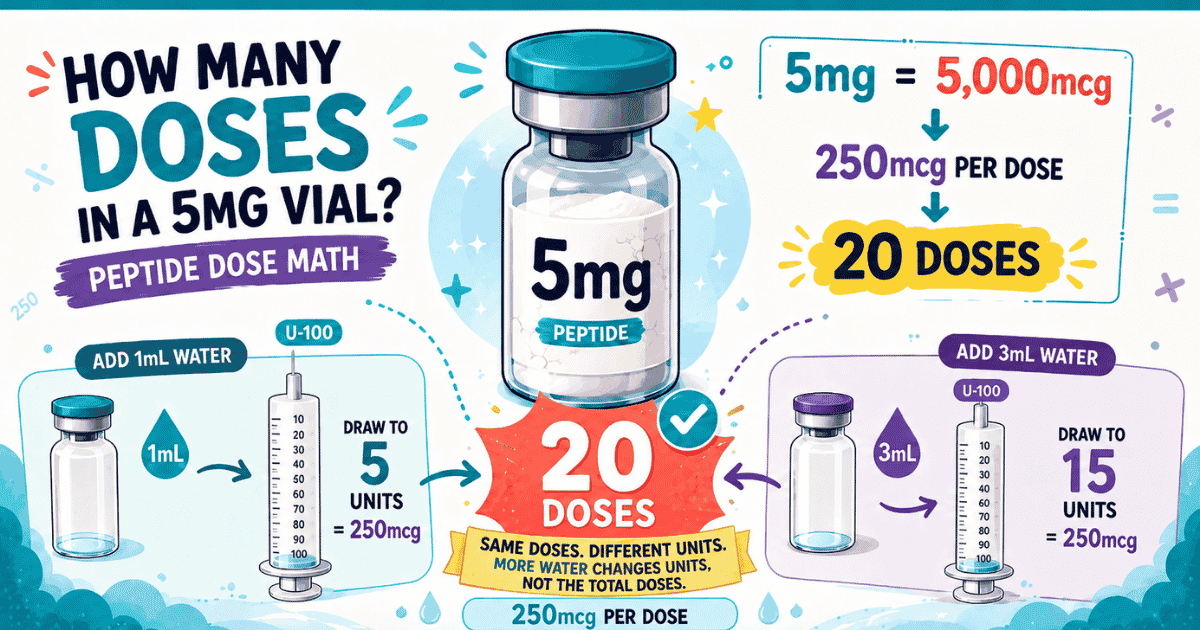
A stated purity below 100% has a practical consequence: each draw delivers slightly less active compound than the label arithmetic implies. Good dose math accounts for that. In PinTrax, a vial record holds the CoA and purity fields alongside the label amount, and the reconstitution math uses stated purity so the calculator reflects what's actually in the draw rather than the round number on the cap.
FAQ
What does 99% purity actually mean?
It means 99% of the material the HPLC test detected is the target molecule, with the remaining 1% being related impurities or residue. It's a measure of composition, not of identity or safety, and it applies only to the batch that was tested.
How do I verify a Janoshik report is real?
Find the unique verification key on the certificate and enter it at Janoshik's own verification page. If it resolves, the report is genuine; if it doesn't, the document is fabricated. Also confirm the batch number matches your vial and the date is recent.
What's the difference between purity and quantity on a CoA?
Purity is the percentage of the detected material that is the target compound. Quantity is how much compound the sample actually contained, checked against the label claim. A vial can hit a high purity figure while testing slightly over or under its stated mass.
Does a CoA mean a product is safe?
No. A CoA reports identity, purity, and quantity for one tested batch. It doesn't certify sterility, cover your specific vial, or speak to whether a substance is appropriate or legal for any particular use.